
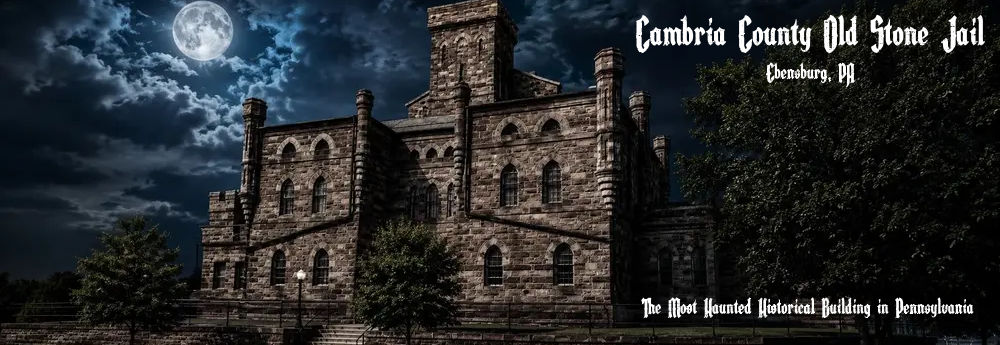
Parts of this information are from the 1997 Article of the Cambria County Heritage Newsletter
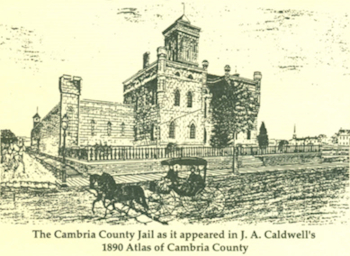
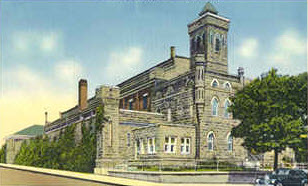
The cornerstone for Cambria County's new prison was laid in 1870 using stone that was quarried in the nearby town of Revloc. The large "castle-like" section and surrounding stone wall of the jail was completed in 1872. The cost was a staggering $73,000. Equivalent to $1,852,803 today.
During the early 1870's there was a major effort by the people of Johnstown to have the county seat moved from Ebensburg to their more rapidly growing city. It is entirely possible that the jail planners may have built and paid for a building which was a little larger than they needed at the time in order to solidify Ebensburg's status as the county seat. Talk of moving the county seat fell to a trickle following construction of the new jail and it completely died off in 1882 when the current courthouse was built.
The first Court House, built of logs, included a jail located below the court room. A more substantial brick and stone second jail was built between 1828-1830 at the southeast corner of Center and Lloyd Streets on land donated by Rees Lloyd.
In the Fall of 1869, and needing a larger facility, land for the third and present structure was purchased at a cost of $2,500 and described as "bounded on three sides by Centre, Crawford and Sample Streets. The square is centrally located and is the finest site in town that could be secured for that purpose."
Selected was architect Edward Haviland’s design in Gothic Revival style which presented the appearance of an inescapable and impenetrable fortress. This undertaking was not without considerable disagreement among many citizens. The well-publicized controversy included references that it was too large, too expensive, that it resembled a penitentiary, a baronial palace or a Welsh castle! Progress in its construction, however, did continue unabated.
The structure, built of cut stone, was 56 feet in width. 130 feet in length, rose to a height of 60 feet and was surrounded by a 22-foot-high stone wall that enclosed a recreation area. The stone used to construct the jail, and the wall was quarried from a site 3 miles west of Ebensburg and close to the nearby small mining town of Revloc. It was known as Morgantown sandstone, which was of gray, tan and reddish color when freshly quarried and tended to weather or bleach to gray after a number of years.
At the front of the building was a tower raising above the 'castle'. Water was pumped into the tower which supplied the whole structure. The front section also contained the living quarters for the Sheriff, who was then also the warden of the prison, and his family.
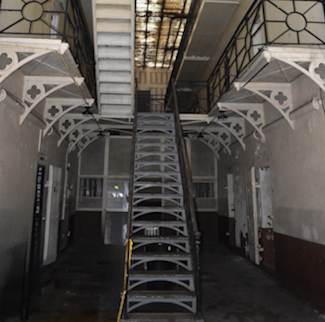
The celling department, which is 100 by 56 feet, contains a lower and upper tier - 14 cells on each level. The cells are 15 by 8, and 9 feet high in the center. The prison, considered a very substantial structure, contained heavy masonry between the 28 cells. They are arranged with a warm air register and one ventilating register, and are sufficiently lighted.
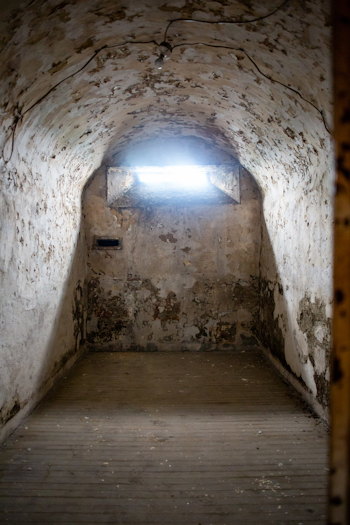
The floors are underlaid with iron plates and covered with concrete, with several cells having a wooden floor laid on top. There are two doors on each cell, with the inside door of wrought iron bars and the outside of heavy oak, both with heavy bolts and locks.
Hygiene at the prison in the early 1900's left much to be desired. One of the rules back then: "Every ten days, or thereabouts, every prisioner in the jail is made to take a bath". The prison was often overcrowded. 123 men would be confined in only 27 cells. There were as many as 16 hoboes confined in one cell at a time.
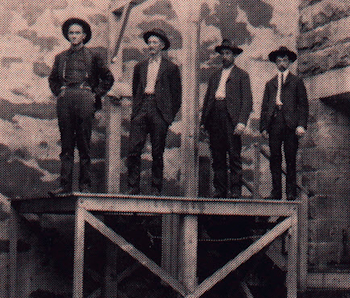
A gallows was constructed at the jail and hangings took place inside the jail yard at the corner of North Center and West Sample Streets. The sheriff performed the execution, as was the custom at the time, and determined how many admission tickets were issued and who would receive them. Those numbers varied from a few to several hundred, depending upon the interest created and/or brutality of the crime committed. The hangings were considered a source of entertainment for county residents until 1909, at which time electrocution replaced them as a means of execution. Hangings ended here in 1909 when condemned prisoners were moved to Rockview Penitentiary, where the electric chair was placed into service.
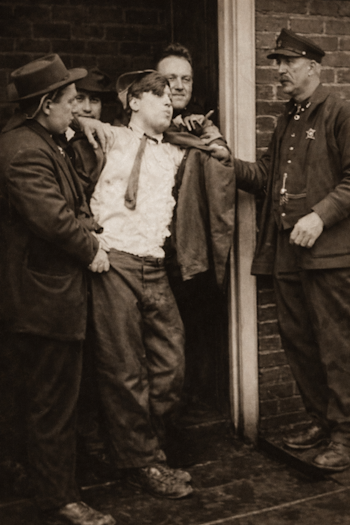
A total of 11 men were executed by hanging in this early prison. One man, Michael Smith, known as "Mickey" or "Peg Leg" to the guards, was scheduled to be the fourth man to be hung but vanished before his execution. He is known in folklore as "The Man They Could Not Hang". He was never recaptured. Another version of his story is rumored that he was murdered at the jail and is the subject of ghost stories. (See his story here.)
The last hanging in this prison was on February 18, 1908. It was a double hanging of Stephen Fellows and Jacob Hauser.
By 1910 it was necessary to enlarge the capacity of the jail, and an addition was built to the rear of the 1872 structure. Two hundred more jail cells together with a bakery and barber shop in the basement were added and an iron and steel cell block which rose 4 stories, all surrounded by brick walls and a roof. Along with these improvements, an electric elevator was installed which ran between the basement and the top tier of cells.
At this time a 3rd floor was also added to the original celling area. This new floor contained a seperate women's quarters as well as an area for work release activities.
Placed on the National Register of Historic Places in 1980, this structure was in May of 1997 closed with the opening of a new $19 million prison facility located in Cambria Township.
Join us on Sundays, 4 PM to 8 PM! Once construction and repairs near completion, we will be opening more days and hours.
Old Stone Jail Tour (1hr)
Explore this National Registered Historical Building with knowledgeable guides. Discover the history of the jail and surrounding
community through stories and artifacts.
- Adult (18-59 Yrs) - $20
- Senior (60 Yrs and Older) - $15
- Student (8-17 Yrs) - $10
- Child (7 Yrs and Younger) - free
Check Availability & Book an Old Stone Jail Tour
Please contact The Tours Team for any questions or booking requests at: Tours@StoneJail.com